
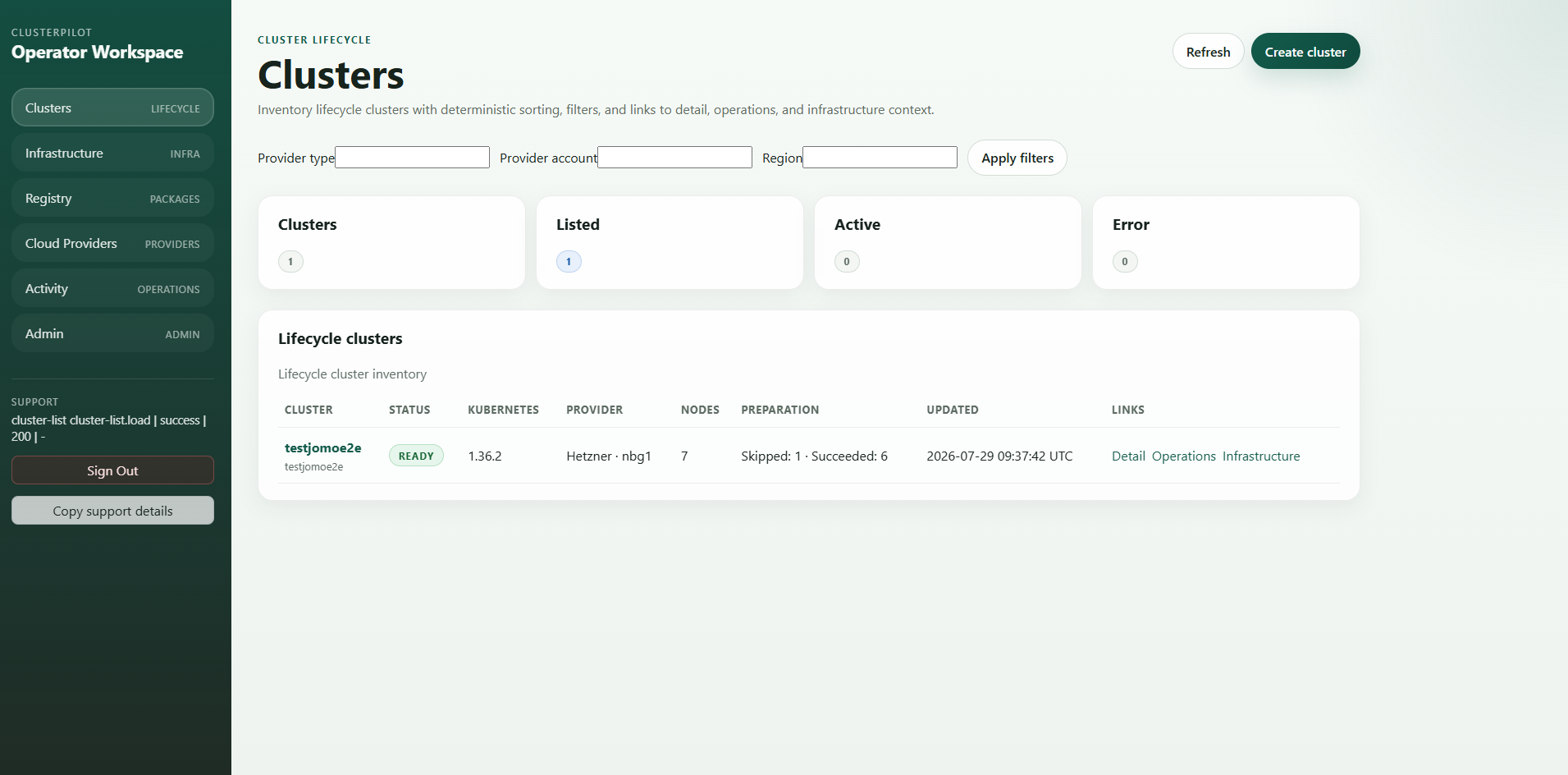
Create clusters
Plan infrastructure, verify prerequisites and provision Kubernetes through a documented workflow.
Controlled self-service Kubernetes
ClusterPilot turns recurring cluster work into reviewable workflows. Teams can request and follow approved operations without sharing permanent administrator access or rebuilding the process from tickets and shell history.
Self-service Kubernetes at a glance
Authorized users start the right workflows through a clear interface. The platform team defines choices, permissions and requirements.
Plan infrastructure, verify prerequisites and provision Kubernetes through a documented workflow.
Add or reduce nodes through a controlled operation and retain every step.
Check versions, compatibility and order before the upgrade and keep the result.
See failure context, diagnostics, node replacement and safe next actions on the operation.
Operational challenge
A portal alone does not create a safe platform. Teams need approved choices, clear ownership, bounded execution and a result that operations and QA can review.
Routine cluster work waits for the few people who know the provider, bootstrap and recovery runbooks.
Direct cluster-admin access makes simple requests fast, but weakens separation of duties and accountability.
A completed request rarely preserves the exact plan, ordered steps, result and cleanup context in one place.
Enterprise value
The value comes from shared state, explicit ownership and reviewable execution.
Provider settings, topologies, versions, add-ons and validation modes come from an explicit supported contract.
Identity, scope, readiness, compatibility and risk are checked before a lifecycle agent reaches the target environment.
Request, actor, plan, status, logs, artifacts and recovery context remain connected to the OperationRun.
Controlled workflow
The platform team defines the permitted path once; authorized users reuse it through the UI or API.
Select a provider, target, lifecycle action, add-on or validation mode within the released capability contract.
Check prerequisites, affected resources, compatibility, permissions and explicit confirmation before mutation.
Assign bounded work to the lifecycle agent and follow ordered steps, status and stable failure context.
Keep artifacts, checksums, cleanup state and recovery guidance available to platform, QA and support teams.
Evidence
Every permitted action produces a durable record instead of a one-time portal response.
Authenticated actor, team, permission, target and confirmation context.
Versioned intent, plan, admission decision, step order, lifecycle-agent assignment and immutable software subjects.
Terminal state, logs, artifacts, cleanup, retry history and a safe next action when work stops.
Frequently asked questions
Short answers about use, workflow and next steps.
Self-service Kubernetes lets authorized users request approved cluster or platform operations without waiting for a manually executed runbook. The platform team still defines permissions, choices, checks and execution boundaries.
ClusterPilot supports workflows for infrastructure planning, cluster creation, inspection, scaling, Kubernetes upgrades, node replacement, deletion, add-on installation and Kubernetes validation.
No. Self-service describes how internal users request work. Managed Kubernetes describes who carries operational responsibility. ClusterPilot is customer-hosted software and does not transfer that responsibility to an external provider.
That is not the ClusterPilot model. The current release exposes bounded workflows and read-oriented operational context rather than generic cluster-admin mutations.
The current evaluated lifecycle path applies to clusters managed by ClusterPilot. A general detach or adoption contract is not claimed for v0.0.5.
Start with a measurable workflow
We review your environment and current workflow, then show the implementation with ClusterPilot.
hello@clusterpilot.de